

Black Hot Reveal!
Nov. 23, 2025: Overcast skies, wind S 5MPH, 38F; sunset time 4:15PM
After checking staging areas along Merrimack Street, we settled near the truck depot on South Canal Street, an excellent vantage point for watching the first arrivals of the night. Early arrivals glided in quietly, followed soon after by large, steady flight streams pouring in from the southeast and additional flows from the east and downriver. The growing volume and coordinated timing signaled that the nightly roost was quickly taking shape.
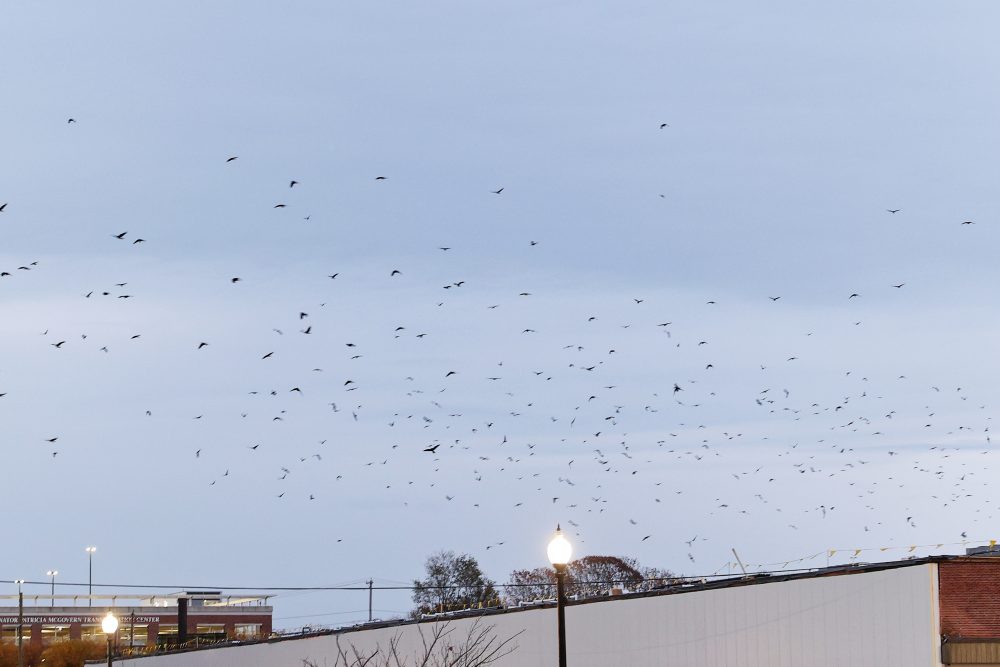
As the light faded, the initial buildup of crows in the riverside trees became increasingly noticeable. The National Grid substation again served as a major staging hub, and the trees west of the New Balance building filled early with long stretches of birds settling in clusters. Their active vocalizations and slow shifting among branches created that familiar pre-roost tension, a transitional moment when the Crows assesses the night’s conditions and prepares for the final convergence into the roost.
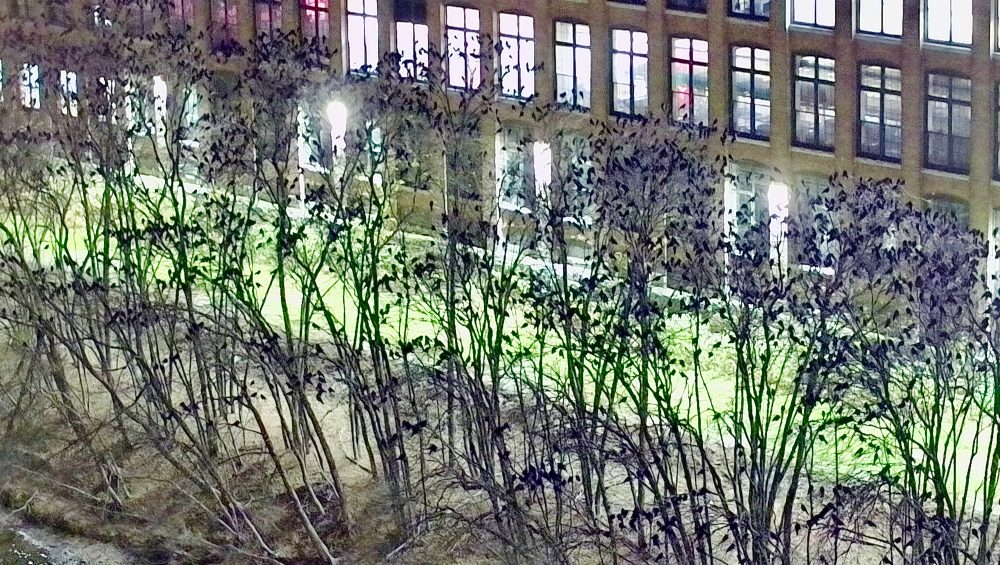
Roughly thirty minutes after the 4:15 PM sunset, the scene intensified as large late-arriving groups lifted from their staging areas and streamed directly into the main roost. The density along the New Balance building increased rapidly, with additional birds filling the trees both to the west and on the east side of the Duck Bridge. Using a very low-light aerial camera during this phase made an extraordinary difference, producing clearer outlines, better separation between birds and branches, and far more definition of the overall roost structure as it tightened for the night.
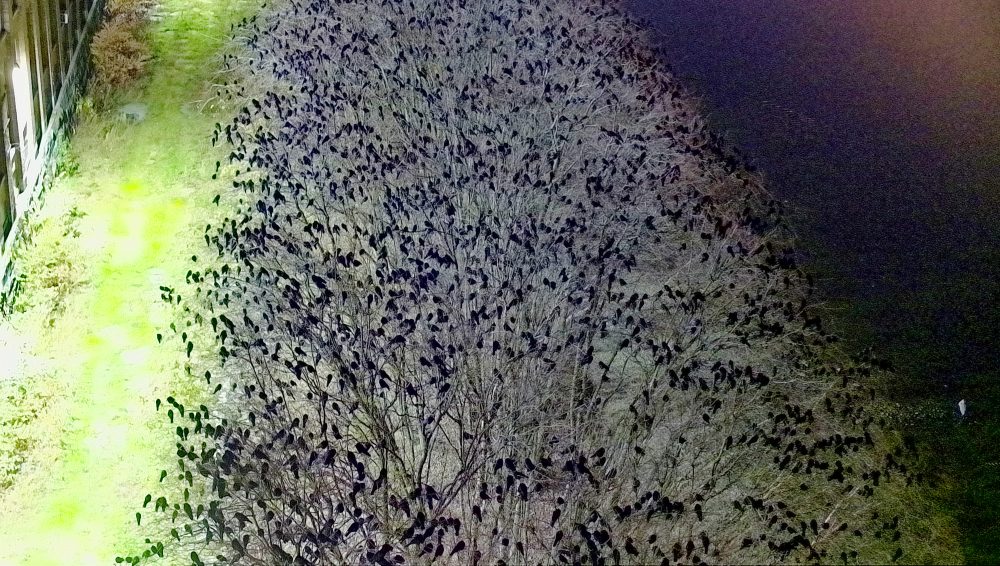
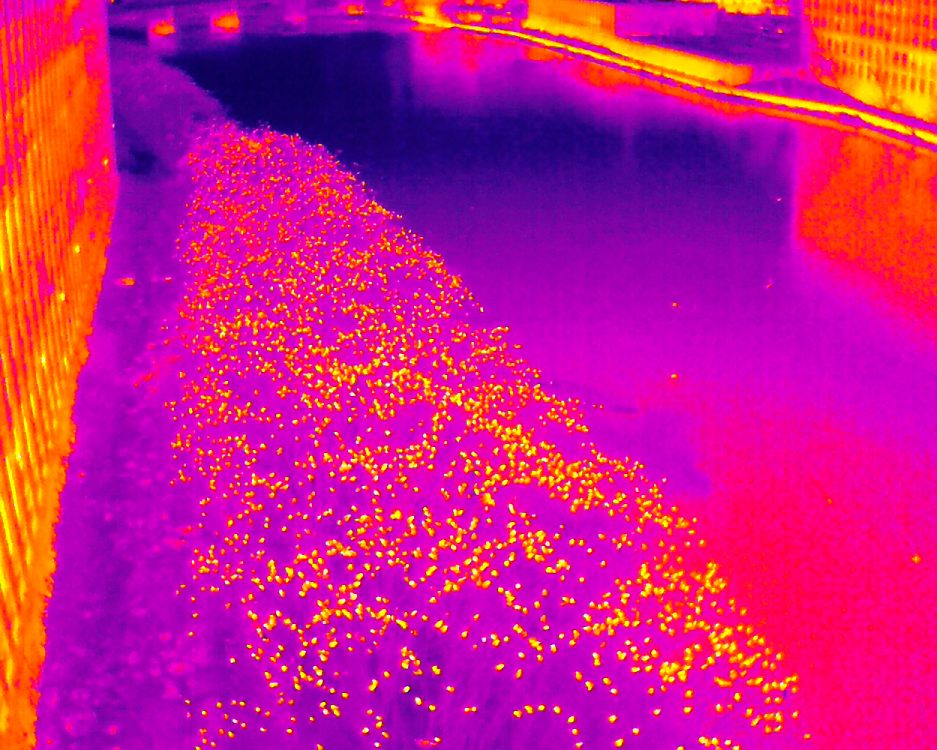
The roost’s true extent became even more apparent through thermal aerial imaging, which continues to transform how we understand these winter crow gatherings. The thermal views revealed long, glowing bands of densely packed birds, distinct pockets of heavier concentration, and subtle variations in heat signature that define how the flock distributes itself across the trees. This technology provides a groundbreaking new perspective on roost size, organization, and behavior, offering insights impossible to capture with visible light alone and deepening our appreciation for the complexity of this urban winter spectacle.
For the 2024 Audubon Christmas Bird Count (CBC) for the Andover Circle (MAAN), the separate Crow Count was a total 12,550 Crows, including American Crows and Fish Crows. In 2023, the CBC Andover Circle Crow Count was 11,600. Many thanks to Donna Cooper who coordinates and compiles the CBC Andover Circle each year! Craig serves as the designated sector leader for the crow roost count.
The counts and methods meticulously developed by the Crow Patrol for the Lawrence roost were reviewed and approved in January 2021. This took place after a full review of all field notes and images, followed by group discussion with Wayne Petersen, the New England Regional Editor for the CBC, full support from Geoff LeBaron, the National Director of the CBC, and Donna Cooper as the local CBC Count Circle compiler. After this comprehensive review process, the final count for American Crows for the 2020 CBC was set at 15,200. This final count reflected the detailed field reports and imaging provided by members of the Crow Patrol. This count number was also in total alignment with a long list of experienced local birders who have made prior counting visits to this winter roost in Lawrence, MA!
As a result of substantial input from Geoff LeBaron, the National CBC Director, we are now using enhanced methods for counting the large number of Crows while streaming, staging, and settling into the roost. For all counts, we utilize multiple direct block counts of the Crows in flight and later while the Crows are perched in trees, always while standing and walking around outside (not sitting in a car after dark) around the roost. For all roost images, we use a modified open source counting software program, to carefully document and cross check our count numbers. This comprehensive approach significantly increases the reliability and accuracy of our carefully documented results. Please refer to our newly published Winter Crow Roost counting guide PDF on the main page.
For our still images, the Canon R6 mirrorless cameras excels in low-light photography due to its 24 MP sensor with fewer and larger pixels, allowing for better light collection and signal-to-noise ratio. The R6 II offers high dynamic range for detail retention, low digital noise even at high ISOs (up to 102,400), effective image stabilization for sharper images, and advanced image processing to minimize noise in dark areas.
The Canon mirrorless cameras with the RF 50mm f/1.2 lens and the RF 28-70mm F2 lens excel in low-light conditions, blending versatile focal lengths with an ultra-wide aperture. Both focal lengths work extremely well in very low light conditions because the f/1.2 and f2 aperture settings ensure exceptional performance in low light, offering stunning clear, and aesthetically pleasing images, making them ideal for the challenging very low light conditions around any overnight winter crow roost.
Remember to check out the latest Crow Patrol Podcast with John Macone (Merrimack River Watershed Council): wintercrowroost.com/podcast/
Photo gear used for most outings:
Canon EOS 80D with Canon EF-S 18-135mm f/3.5-5.6 IS
Canon EOS 80D with Canon EF-S 18-135mm f/3.5-5.6 IS (Infrared)
Canon EOS R6 Mirrorless with Canon RF 28-70 f/2 L IS USM
Canon EOS R6 II Mirrorless with Canon RF 50 f/1.2 L USM
Sony AX700 4K HDR Camcorder
Follow us on Instagram: wintercrowroost
Follow us on YouTube: wintercrowroost
Leave A Comment