

Dec. 18, 2025: under partly cloudy skies, light wind, 41F, sunset time 4;12PM
With real gratitude and admiration, I want to recap a memorable winter evening spent with David and Mark in Manchester, two deeply engaged birders whose careful observations and thoughtful documentation are already adding meaningful value to our collective understanding of winter crow roosts. Their willingness to get out consistently, note precise timing and numbers, and share detailed eBird entries reflects exactly the kind of attentive, community-minded birding that strengthens projects like the Winter Crow Roost. It was a pleasure to stand alongside them and see their local knowledge and enthusiasm in action!
We began the evening focused on incoming flight streams, watching crows arrive in flight lines from multiple directions as daylight faded. These flight paths, steady and directional, told a familiar story, birds funneling in from feeding areas, often high at first, then lowering as they approached the roost zone. David and Mark were quick to note shifts in direction and volume, calling out initial estimates and patterns that spoke to their experience as active birders. It was especially rewarding to see how their suggested counts align with what we observed in real time, reinforcing the importance of careful, repeated observation over the course of the season.
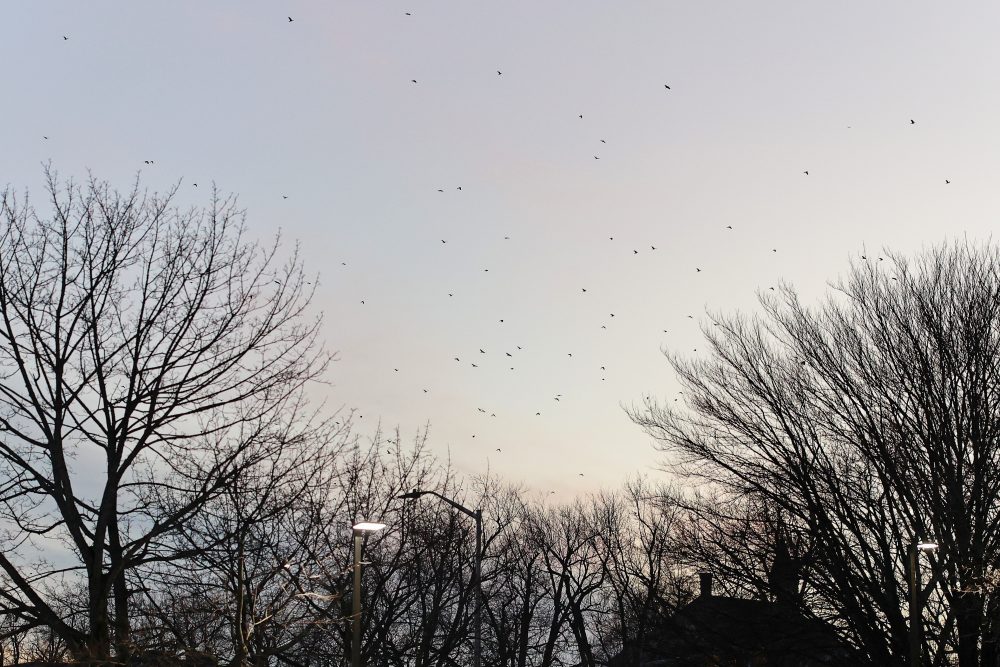
As activity intensified, we walked along Dionne Drive, where the evening truly came alive. Multiple flight bursts swept overhead and into nearby treetops, accompanied by loud, animated vocalizations that echoed through the area. Crows arrived, lifted off, circled, and resettled—sometimes repeatedly—as social interactions played out above us. The air was full of sound and motion, and the scene offered a vivid reminder that roosting is not a quiet or passive process, but a dynamic social event. David and Mark’s excitement was palpable, and their shared comments captured the scale and energy of these movements beautifully.
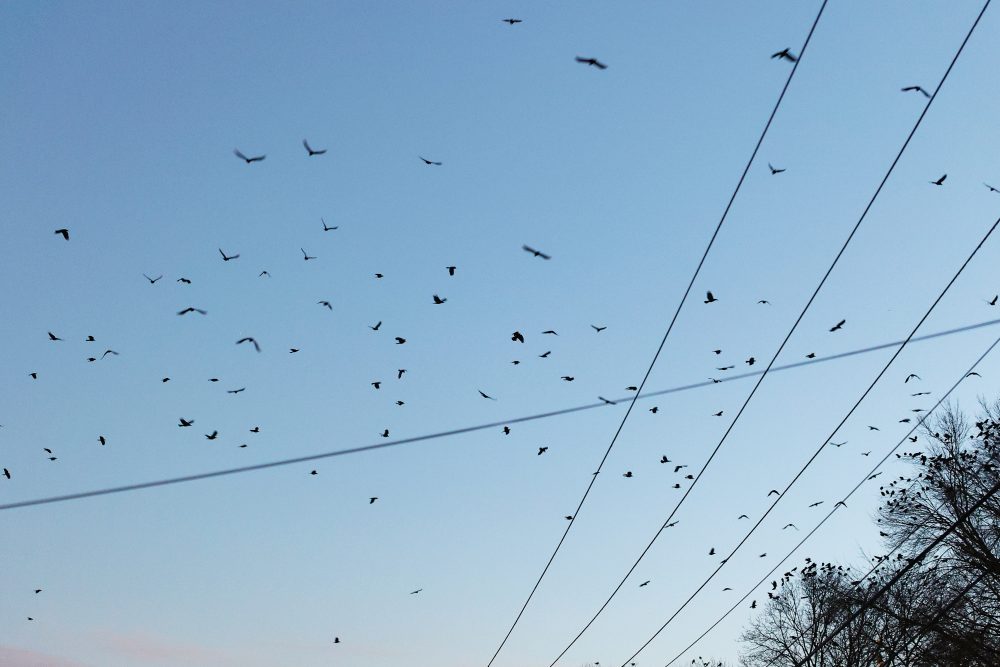
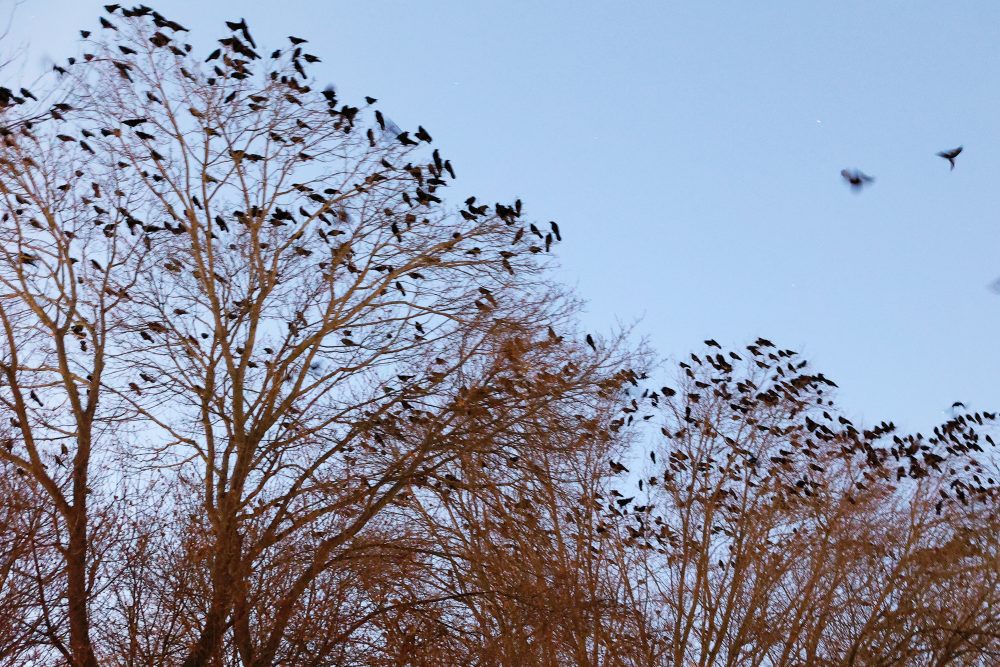
Finally, as darkness fully set in, we watched the crows settle into the overnight roost trees, the tempo gradually slowing as calls softened and movement diminished. What had been swirling, vocal, and energetic resolved into stillness, with thousands of birds tucked into their chosen trees for the night. Standing there, it was impossible not to appreciate the patience and dedication it takes to witness this full arc, from first arrivals to final settling. David and Mark are doing exemplary work, and their careful counts, clear reporting, and genuine curiosity deserve real praise. Manchester’s winter crows are in very good hands!
For the 2024 Audubon Christmas Bird Count (CBC) for the Andover Circle (MAAN), the separate Crow Count was a total 12,550 Crows, including American Crows and Fish Crows. In 2023, the CBC Andover Circle Crow Count was 11,600. Many thanks to Donna Cooper who coordinates and compiles the CBC Andover Circle each year! Craig serves as the designated sector leader for the crow roost count.
The counts and methods meticulously developed by the Crow Patrol for the Lawrence roost were reviewed and approved in January 2021. This took place after a full review of all field notes and images, followed by group discussion with Wayne Petersen, the New England Regional Editor for the CBC, full support from Geoff LeBaron, the National Director of the CBC, and Donna Cooper as the local CBC Count Circle compiler. After this comprehensive review process, the final count for American Crows for the 2020 CBC was set at 15,200. This final count reflected the detailed field reports and imaging provided by members of the Crow Patrol. This count number was also in total alignment with a long list of experienced local birders who have made prior counting visits to this winter roost in Lawrence, MA!
As a result of substantial input from Geoff LeBaron, the National CBC Director, we are now using enhanced methods for counting the large number of Crows while streaming, staging, and settling into the roost. For all counts, we utilize multiple direct block counts of the Crows in flight and later while the Crows are perched in trees, always while standing and walking around outside (not sitting in a car after dark) around the roost. For all roost images, we use a modified open source counting software program, to carefully document and cross check our count numbers. This comprehensive approach significantly increases the reliability and accuracy of our carefully documented results. Please refer to our newly published Winter Crow Roost counting guide PDF on the main page.
For our still images, the Canon R6 mirrorless cameras excels in low-light photography due to its 24 MP sensor with fewer and larger pixels, allowing for better light collection and signal-to-noise ratio. The R6 II offers high dynamic range for detail retention, low digital noise even at high ISOs (up to 102,400), effective image stabilization for sharper images, and advanced image processing to minimize noise in dark areas.
The Canon mirrorless cameras with the RF 50mm f/1.2 lens and the RF 28-70mm F2 lens excel in low-light conditions, blending versatile focal lengths with an ultra-wide aperture. Both focal lengths work extremely well in very low light conditions because the f/1.2 and f2 aperture settings ensure exceptional performance in low light, offering stunning clear, and aesthetically pleasing images, making them ideal for the challenging very low light conditions around any overnight winter crow roost.
Remember to check out the latest Crow Patrol Podcast with John Macone (Merrimack River Watershed Council): wintercrowroost.com/podcast/
Photo gear used for most outings:
Canon EOS 80D with Canon EF-S 18-135mm f/3.5-5.6 IS
Canon EOS 80D with Canon EF-S 18-135mm f/3.5-5.6 IS (Infrared)
Canon EOS R6 Mirrorless with Canon RF 28-70 f/2 L IS USM
Canon EOS R6 II Mirrorless with Canon RF 50 f/1.2 L USM
Sony AX700 4K HDR Camcorder
Follow us on Instagram: wintercrowroost
Follow us on YouTube: wintercrowroost
This information is spectacular. I’m a long time birder but just learning about these crow roosts. Just this winter I am seeing dozens of crows every morning flying from the north east (ish) towards the north west (ish) I have never noticed this happening in years past so I started googling it and found your site. I am going to check out the lawrence site and the manchester site to try and figure out where the crows in Derry are flying from every morning…Thanks for the work you do. Susan