

Jan. 19, 2025 under overcast skies, wind SW at 8MPH, 24F; sunset time 4:41PM
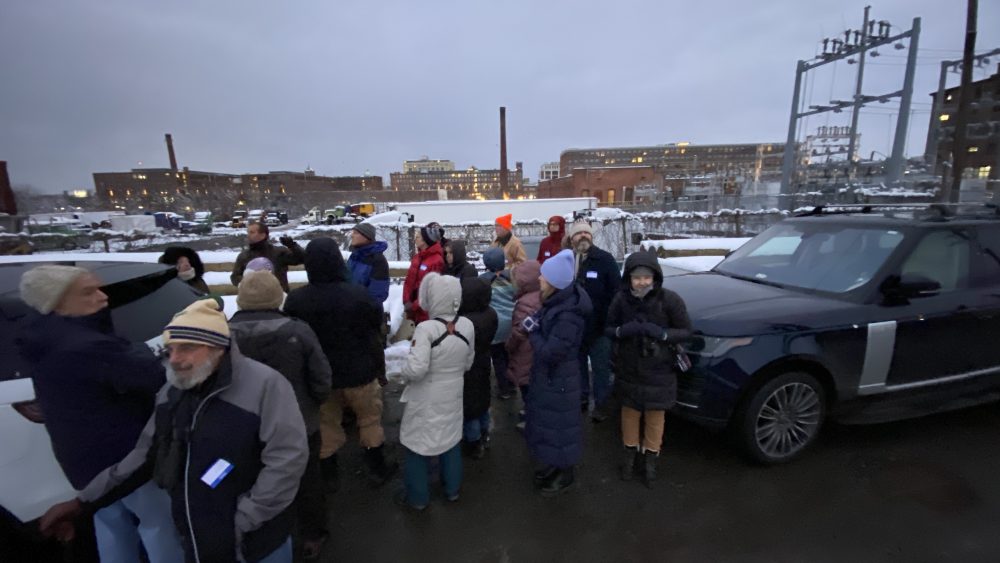
Monday night brought a terrific turnout of members from the Merrimack Valley Bird Club, gathered under the outstanding leadership of Donna Cooper for another unforgettable evening at the Lawrence winter crow roost. With clear views, active birds, and the added perspective of aerial imagery, the evening offered both spectacle and insight into how this large communal roost takes shape after sunset.
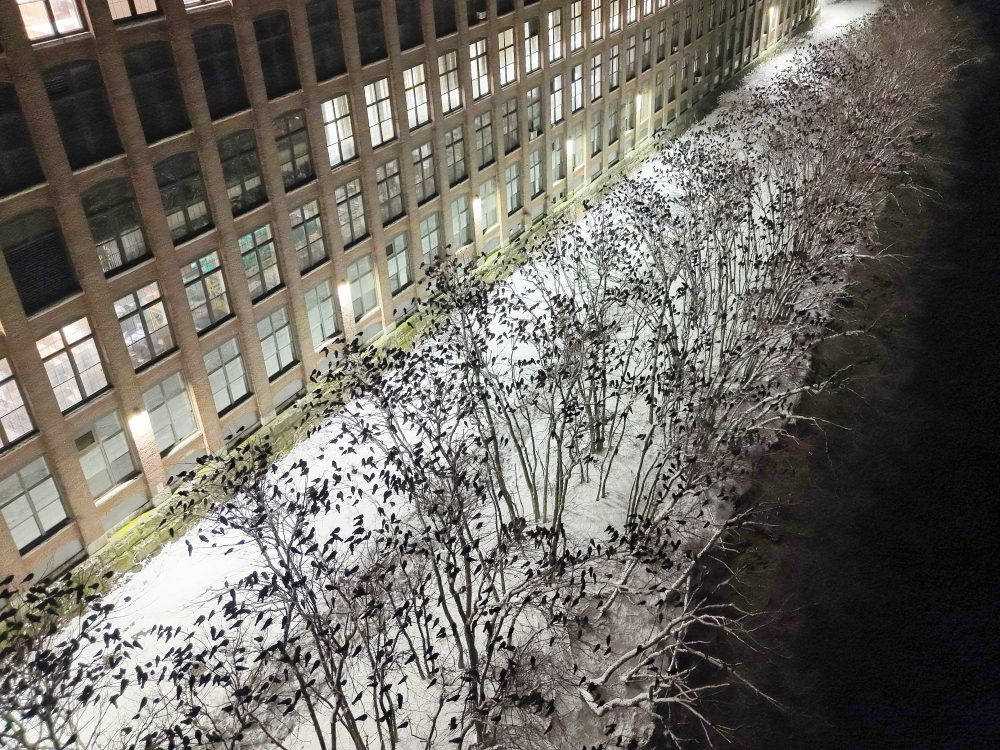
The first aerial image, captured in natural-color (RGB) just after dusk, looks along the line of riverside trees bordering the Merrimack River near the New Balance building. From this angled perspective, the early structure of the roost becomes clear, with crows already well settled into favored trees. The soft ambient light highlights silhouettes of birds spaced along branches, revealing the orderly foundation of what will soon become a densely packed overnight roost.
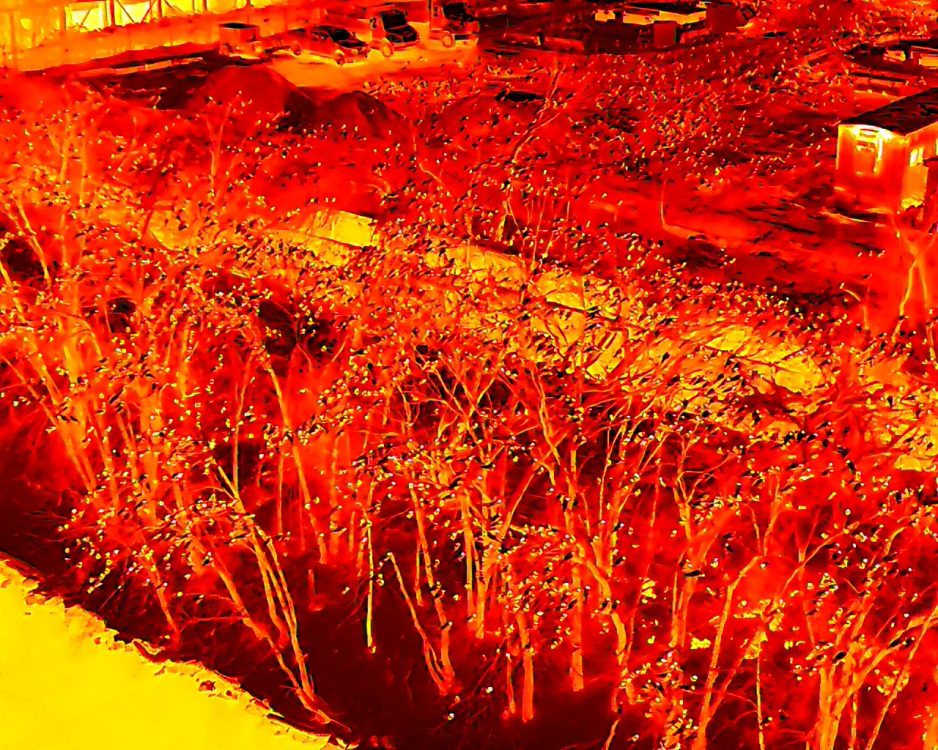
From over the Merrimack River, the second image looks southeast toward the line of roosting trees behind the National Grid substation, using a distinctive thermal color palette with bright reds, yellows, and whites. This vivid palette offers exceptional clarity, making it easy to distinguish individual birds, clusters, and subtle movements within the roost. Farther back, crows on the ground remain clearly visible as bright heat signatures, emphasizing the layered nature of staging and settling that continues even after many birds have taken to the trees.
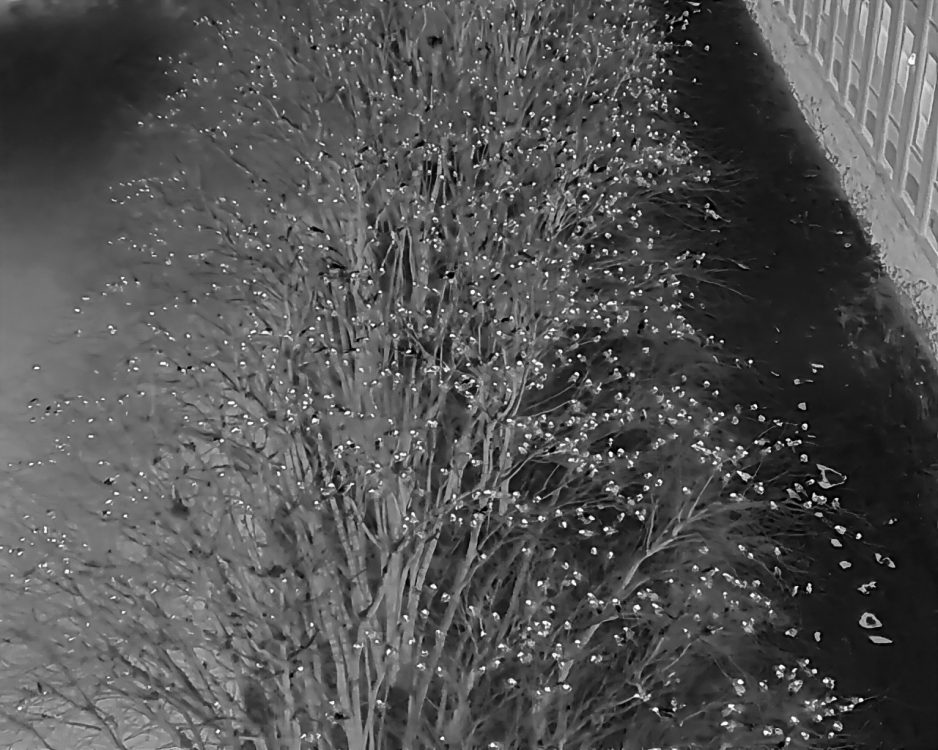
The third image looks straight east down the length of the riverside trees alongside the New Balance building, using a white-hot thermal palette. From this viewpoint, the sheer density of the roost is unmistakable. Tree after tree appears fully occupied, with the brightest signatures marking concentrations of birds packed tightly into the canopy. This perspective beautifully illustrates both the scale and uniformity of the roost as it stretches along the river’s edge.
The final image returns to natural-color (RGB) imagery, captured well after dark from an angled aerial view looking southwest behind the National Grid substation. In the low-light setting, the earlier frenzy has given way to calm. The roost trees stand dark against the night sky, with faint highlights revealing where birds have settled for the night. It’s a peaceful closing scene—one that contrasts sharply with the boisterous arrivals earlier in the evening and underscores the remarkable daily rhythm of this winter crow roost.
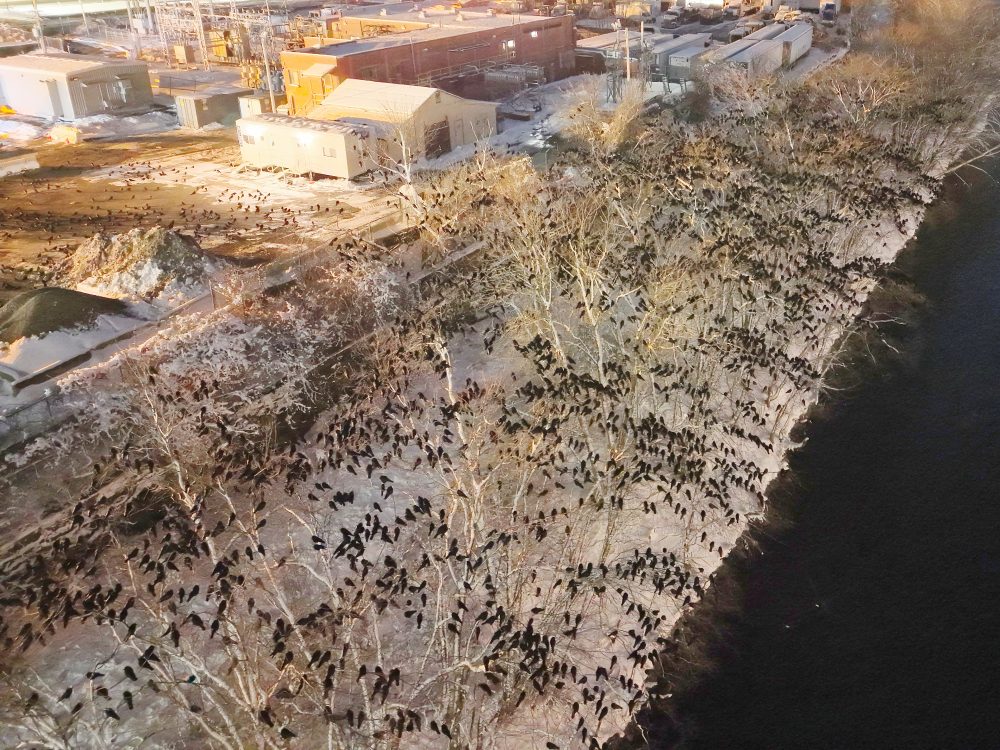
Evenings like this highlight the special blend of community, curiosity, and shared discovery that makes these crow roost walks so rewarding. Many thanks to the members of the Merrimack Valley Bird Club for such an enthusiastic turnout, and to Donna Cooper for her outstanding leadership and thoughtful guidance throughout the evening. Together, ground-based observations and aerial perspectives continue to deepen our understanding of this remarkable winter roost, while offering all of us a memorable window into one of nature’s most dynamic nightly gatherings.
For the 2025 National Audubon Christmas Bird Count (CBC) for the Andover Circle (MAAN), the dedicated crow roost count totaled 14,025 crows, including both American Crows and Fish Crows. By comparison, the Andover Circle crow count was 12,550 in 2024 and 11,600 in 2023. Many thanks to Mark Morroni and Donna Cooper, who coordinated and compiled the Andover Circle CBC this year. Craig serves as the designated sector leader for the Lawrence winter crow roost count.
The counting methods developed by the Crow Patrol for the Lawrence roost were formally reviewed and approved in January 2021 following a detailed evaluation of field notes, images, and group discussion with Wayne Petersen, New England Regional Editor for the CBC, with full support from Geoff LeBaron, National Director of the CBC, and Donna Cooper as local compiler. After this comprehensive review, the 2020 CBC American Crow count was finalized at 15,200, a figure fully supported by field documentation and consistent with long-term observations by experienced local birders.
Building on guidance from the National CBC leadership, we now use enhanced, field-based counting methods tailored to large winter crow roosts. These include multiple direct block counts of birds in flight, during staging, and once perched, conducted entirely on foot around the roost. Counts are later cross-checked using still images and video, supported by modified open-source counting software. This multi-layered approach significantly improves accuracy and repeatability. A detailed overview of these methods is available in the Winter Crow Roost Counting Guide (PDF) on the main page.
All images are captured using professional low-light mirrorless camera systems and fast-aperture lenses, allowing for reliable documentation under the very challenging lighting conditions at dusk and after dark typical of winter crow roosts.
Leave A Comment