

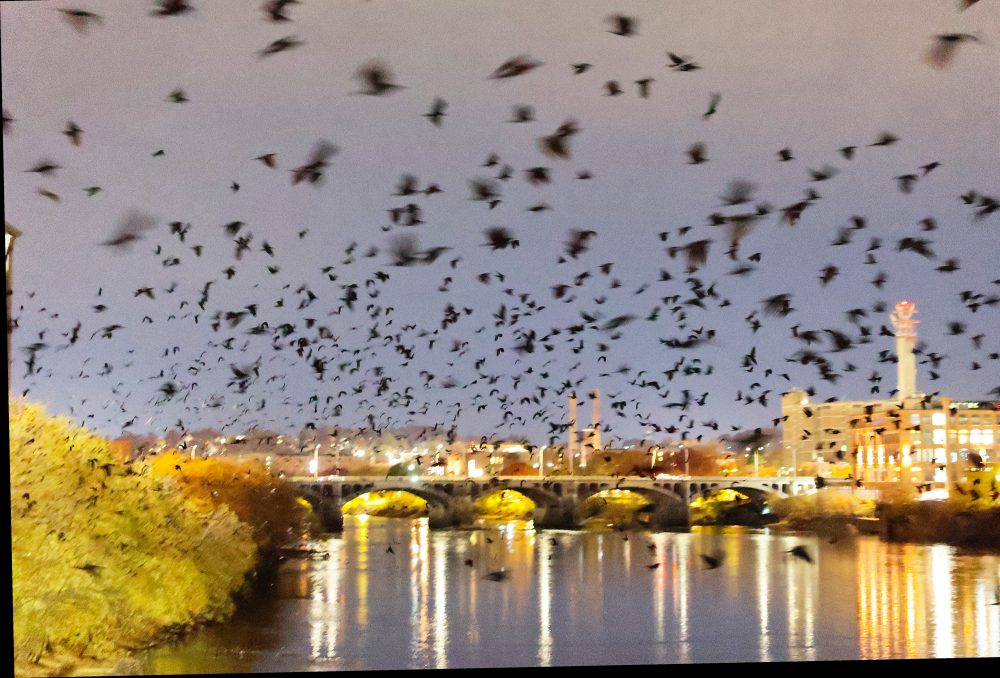
Nov. 2, 2026 under clear skies, wind SW 2 MPH, 63F. Surveyed along Merrimack Street from the Rt. 495 overpass up to Parker St. and nearby side streets, with larger numbers of Crows building up on rooftops along Merrimack Street. Then watched the Crows converge into the overnight roost trees along the New Balance building on the south side of the Merrimack River and in trees on both sides of the Union Street Duck Bridge. While observing from the Duck Bridge, we witnessed a spectacular flight burst, with an estimated 500–700 Crows suddenly filling the evening sky. With Crows flying overhead, the sounds of their calls, and the illuminated Casey Bridge in the background, it was an exhilarating moment in the evening gathering process.
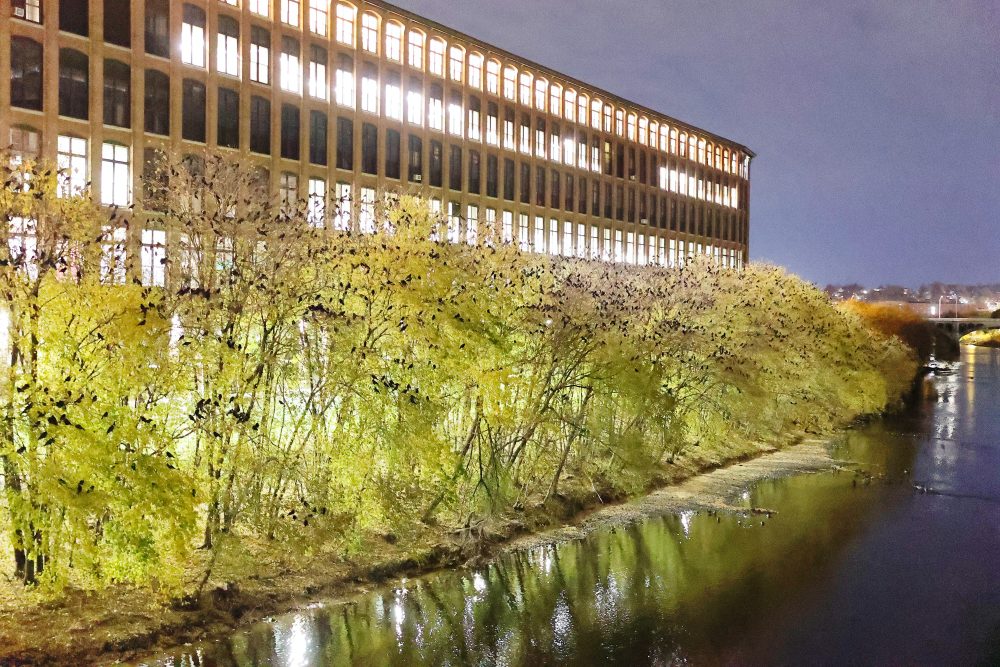
Looking west along the riverfront, this traditional nighttime photograph captures the remarkable gathering of Crows settling into the trees alongside the historic New Balance mill building. With an estimated 850+ Crows visible, the illuminated trees and lingering fall foliage provide a beautiful setting for this extraordinary urban wildlife spectacle. Yet much of the activity within the interior and lower reaches of the canopy remains hidden from ordinary view.
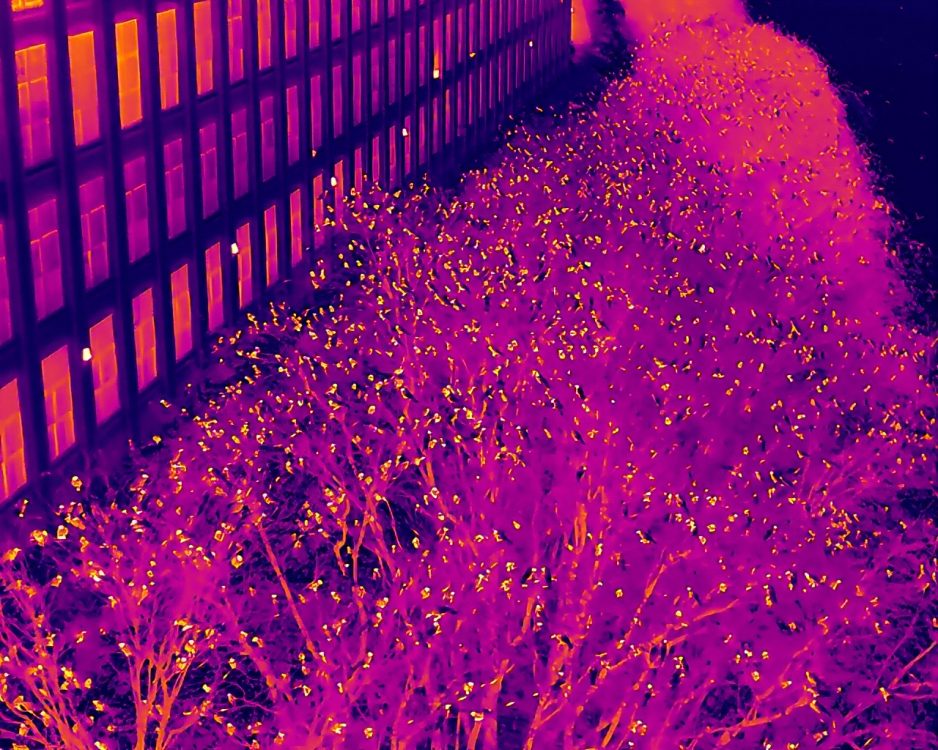
Taking to the air with thermal imaging technology, we gain a stunning new perspective on the depth and density of the overnight roost. This angled aerial “Iron Red” palette view reveals an estimated 1,500+ Crows distributed throughout the riverfront canopy. The individual thermal signatures provide a fascinating glimpse into the abundance of Crows occupying the trees, including many that are difficult to distinguish through traditional nighttime photography.
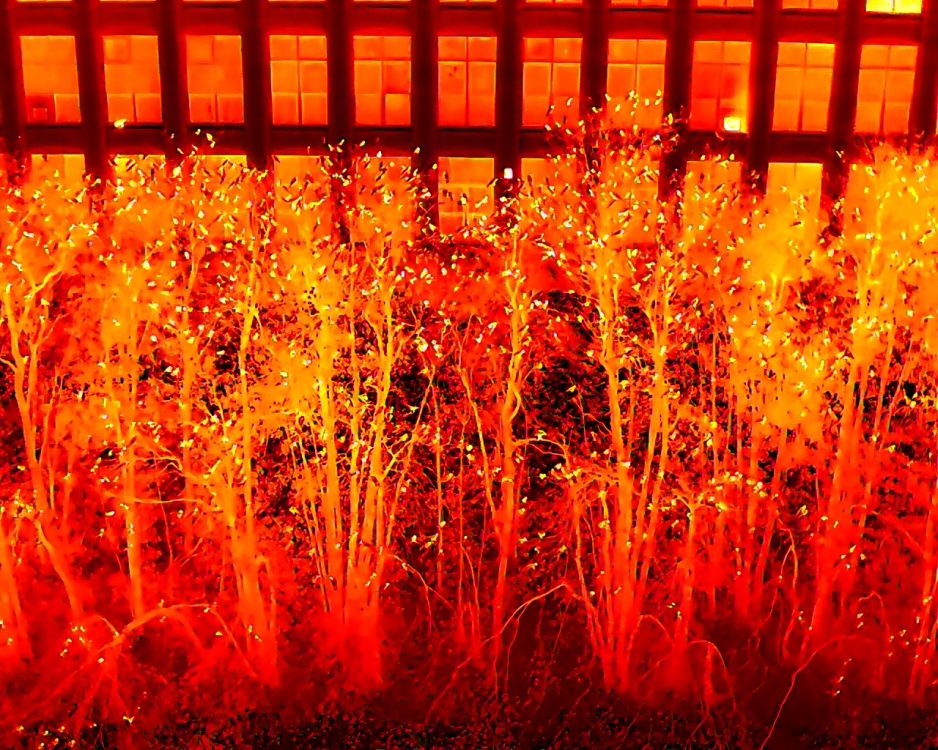
Perhaps most revealing is this direct lateral thermal view, capturing an estimated 750+ Crows perched at varying heights throughout the trees. From the uppermost branches to the surprisingly low perches near the ground, we begin to appreciate the remarkable three-dimensional structure of the winter crow roost. The variations in density, vertical distribution, and individual spacing offer exciting new opportunities to better understand communal roosting behavior. Having revealed this hidden world through aerial thermal imaging, our next RoostWatch investigation will explore the challenge of accurately counting the thousands of Crows occupying these trees.
For the 2025 National Audubon Christmas Bird Count (CBC) for the Andover Circle (MAAN), the dedicated crow roost count totaled 14,025 crows, including both American Crows and Fish Crows. By comparison, the Andover Circle crow count was 12,550 in 2024 and 11,600 in 2023. Many thanks to Mark Morroni and Donna Cooper, who coordinated and compiled the Andover Circle CBC this year. Craig serves as the designated sector leader for the Lawrence winter crow roost count.
The counting methods developed by the Crow Patrol for the Lawrence roost were formally reviewed and approved in January 2021 following a detailed evaluation of field notes, images, and group discussion with Wayne Petersen, New England Regional Editor for the CBC, with full support from Geoff LeBaron, National Director of the CBC, and Donna Cooper as local compiler. After this comprehensive review, the 2020 CBC American Crow count was finalized at 15,200, a figure fully supported by field documentation and consistent with long-term observations by experienced local birders.
Building on guidance from the National CBC leadership, we now use enhanced, field-based counting methods tailored to large winter crow roosts. These include multiple direct block counts of birds in flight, during staging, and once perched, conducted entirely on foot around the roost. Counts are later cross-checked using still images and video, supported by modified open-source counting software. This multi-layered approach significantly improves accuracy and repeatability. A detailed overview of these methods is available in the Winter Crow Roost Counting Guide (PDF) on the main page.
Leave A Comment